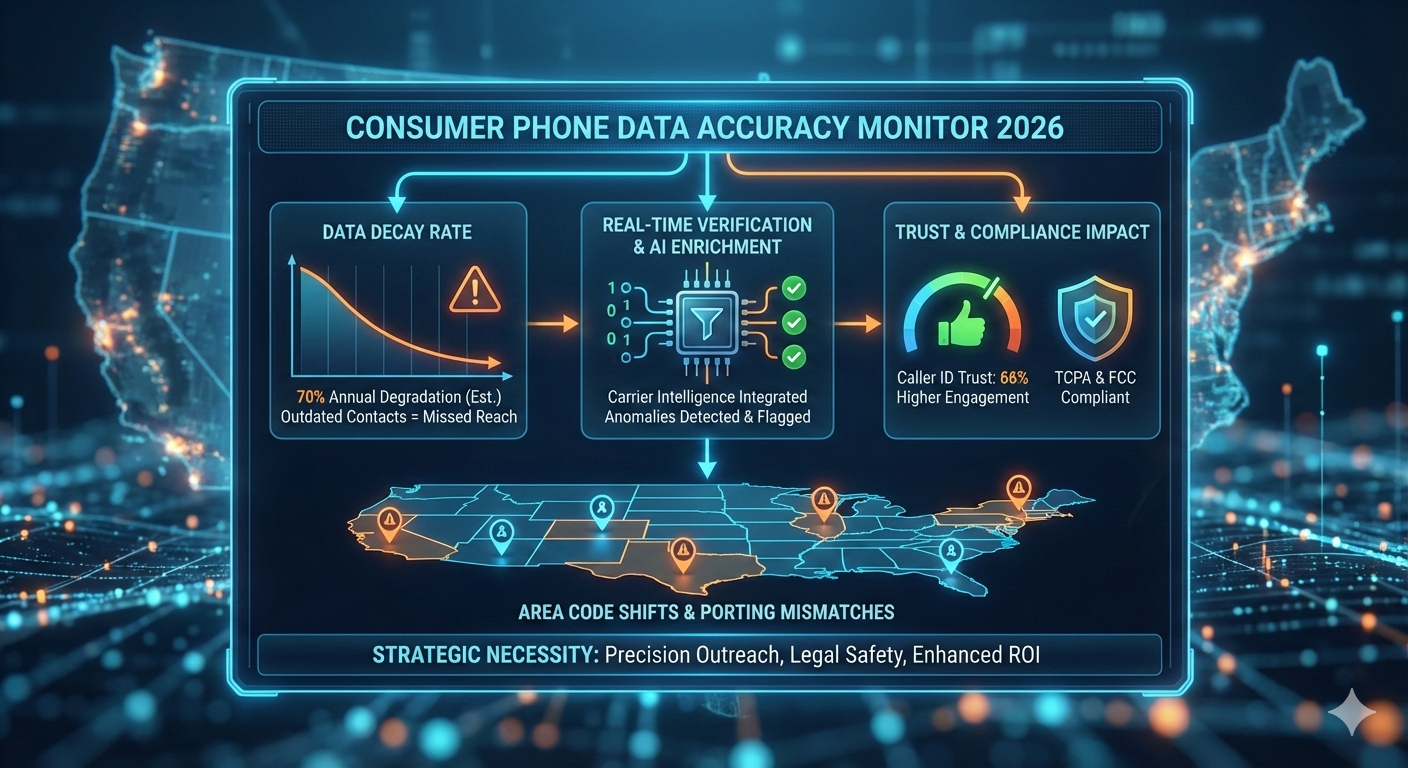
Most marketers are sitting on a ticking time bomb and do not know it. Their phone database, the one powering outreach, follow ups, and compliance workflows, is quietly decaying. By the time they notice, thousands of dials have already hit dead ends, spam filters, or worse, TCPA violations.
Phone data accuracy in 2026 is no longer a back office hygiene issue. It directly affects whether your campaigns reach real people, whether your caller ID builds trust or gets ignored, and whether your compliance posture holds up under scrutiny.
This guide covers the biggest shifts reshaping phone data quality right now, along with a practical playbook for improving phone data accuracy, maintaining compliance, and keeping your database ready to convert. If you want a faster way to fix your data, explore professional phone append services for real time validation and enrichment.
Table of Contents
How to Improve Phone Data Accuracy in 2026
Improving phone data accuracy starts with validating, enriching, and continuously monitoring your contact database.
The best approach combines real time phone number validation, data appending, and regular database audits so every number is active, correctly assigned, and suitable for outreach.
Here are the core steps marketers are using today:
- Validate phone numbers at the point of entry using real time validation tools.
- Re verify numbers before every campaign to reduce decay issues.
- Use phone append services to enrich missing or outdated records.
- Segment records based on validation status and recency.
- Track accuracy metrics such as invalid rates and contact rates.
Taken together, these steps help keep phone number accuracy high and make your outreach more effective.
Key Phone Data Accuracy Statistics
Trend 1: The Phone Data Decay Crisis Is Getting Worse
How Fast Does Phone Data Decay?
Phone data typically decays by 20 to 70 percent per year without maintenance. Industry research consistently shows that even on the conservative end, a database of 10,000 phone numbers could have 2,000 bad records within a year, and that number compounds over time. The drivers of decay are structural: consumers change carriers frequently, numbers are ported across regions, and disconnected numbers are reassigned to new individuals.
What It Actually Costs You
Beyond wasted dials, poor phone data quality affects sales productivity, campaign performance, and compliance risk. Every time your system contacts a reassigned number, you risk reaching someone who never consented, which increases TCPA exposure.
Trend 2: Caller ID Accuracy Drives Answer Rates
Two thirds of consumers are more likely to answer calls when caller ID information appears accurate and trustworthy.
The Spam Label Problem
Even legitimate campaigns can be flagged as spam when phone data is outdated or inconsistent. Once labeled, answer rates drop quickly and recovery becomes difficult.
Building Caller ID Trust
- Validate phone numbers before campaigns.
- Register business numbers with CNAM.
- Use branded caller ID solutions.
- Monitor number reputation regularly.
- Implement STIR SHAKEN authentication.
Pro tip: For integrated strategies, our omnichannel communications approach helps bridge the gap between caller ID trust and overall customer engagement.
Trend 3: Area Codes No Longer Reflect Location
Area codes are no longer reliable indicators of geographic location because of number portability and mobile usage trends. Incorrect geographic assumptions lead to poor targeting, mistimed calls, and compliance risks. Modern customized data appending provides accurate location data, line type identification, and real time porting updates—turning basic phone number verification into a real advantage.
Trend 4: Data Accuracy Is Now a Compliance Requirement
Phone data accuracy is increasingly tied to TCPA compliance. In 2026, contact data quality is a critical part of a defensible compliance strategy, especially when outreach depends on accurate records and clear consent tracking. For industries with higher scrutiny, like mortgage services, accurate data is the foundation of every campaign. You can learn more about the official TCPA regulations here.
Trend 5: AI Has Transformed Phone Number Validation
Modern phone number verification tools go far beyond checking whether a number is active. They now detect ported numbers, identify VoIP, mobile, and landline numbers, flag high risk numbers, and predict accuracy using AI models.
Best Practices for Maintaining Phone Data Accuracy
- Validate at Entry: Validate every number as it enters your CRM.
- Use Multiple Data Sources: Combine validation, enrichment, and append services.
- Segment Your Data: Fresh data for priority outreach; older data for re verification.
- Enrich Your Data: Use phone append services to improve data completeness.
- Maintain Compliance Records: Document validation and consent history.
- Track Key Metrics: Monitor contact rates, invalid rates, and cost per valid contact.
How Premium Phone Append Helps Solve the Accuracy Problem
Premium Phone Append helps you strengthen your database by adding verified phone numbers to existing records instead of relying on outdated or purchased lists.
Frequently Asked Questions
What is phone data accuracy and why does it matter?
Phone data accuracy refers to how valid, current, and correctly assigned the phone numbers are in your database. It matters because inaccurate data leads directly to wasted campaign spend, lower answer rates, and significant TCPA compliance risks.
How do you improve phone data accuracy?
You improve it by validating numbers in real time, enriching your records with carrier intelligence, and regularly updating your database. The goal is to catch issues at the point of entry rather than cleaning them up in expensive annual batches.
How do you validate a phone number?
You can validate a phone number using real time validation tools that check against carrier data. These tools confirm whether a line is active, identify the line type, such as mobile versus landline, and flag high risk numbers before you dial them.
What tools are used for phone number verification?
Tools include phone validation APIs, carrier lookup services, and data appending platforms like Premium Phone Append. These systems integrate with your CRM to verify data as it is collected or before you launch a campaign.
Is phone appending legal under TCPA?
Yes, phone appending itself is legal, but any outreach you conduct using those numbers must strictly comply with TCPA requirements. This includes ensuring you have proper consent for the specific type of communication, whether it is an automated call or a text message.
How often should phone data be updated?
At a minimum, you should validate your database quarterly. However, for high volume outreach programs, monthly re validation is better. For enterprise operations, real time validation at the point of data entry is the gold standard for maintaining a clean, compliant list.