Something has changed in how B2B companies reach their best customers.
It is not the sales process itself. It is not the messaging or the offers. What has changed is the medium through which every touchpoint happens. Your prospects are spending more time on their phones than anywhere else: researching vendors, comparing solutions, and deciding who gets a meeting. If your outreach strategy does not account for that shift, you are already behind.
Mobile data, including verified phone numbers, SMS reachability signals, and cell phone append services, has become one of the most powerful assets a B2B marketing or sales team can hold. This piece looks at why that is true in 2026, where the market is heading, and what it means practically for your lead generation strategy.
Table of Contents
What Is Mobile Data in B2B, and Why Does It Matter in 2026?
Mobile data in B2B refers to verified cell phone numbers, SMS reachability flags, and carrier-validated contact signals attached to individual decision-maker records. It is the single most actionable enrichment layer a B2B sales or marketing team can add to their CRM.
✔ Over 60% of B2B decision makers primarily engage with vendor outreach on mobile devices
✔ SMS open rates reach 90–98% — far exceeding email’s typical 20–25% range
✔ Phone append match rates for U.S. B2B records typically fall between 40–75%, depending on data freshness
✔ AI lead scoring models perform measurably better when underlying records include verified mobile numbers
✔ Verified mobile contact data reduces wasted outreach spend by eliminating disconnected and landline-only records
Why Mobile Data Is No Longer Optional for B2B Teams
The U.S. mobile data market was projected to exceed $147.5 billion in revenue by 2025, and growth continues into 2026. More meaningfully for B2B marketers, mobile is no longer a consumer-only channel. VPs, directors, and C-suite buyers are reviewing proposals, approving shortlists, and responding to outreach from their phones — throughout the workday, not just in off hours.
A contact record missing a mobile number isn’t neutral. It’s a missed engagement window at every stage of the funnel.
For B2B teams, quality mobile data unlocks:
- Multichannel outreach spanning verified SMS, direct calls, and mobile-optimized advertising
- Intent-timed engagement reaching prospects when they’re actively evaluating solutions
- Faster response cycles because mobile creates a more direct path to conversation than email alone
- Scalable personalization built on mobile behavioral signals layered with professional attributes
Mobile-Enriched CRM vs. Email-Only vs. Unenriched: A Direct Comparison
| Metric | Mobile-Enriched CRM | Email-Only CRM | Unenriched CRM |
|---|---|---|---|
| Reachability | High (multi-channel) | Medium (inbox dependent) | Low (blind outreach) |
| Outreach Speed | Immediate via SMS or call | Delayed — email lag + filters | Manual research required |
| Data Completeness | 85–95% | 40–60% | Below 40% |
| SMS Campaign Capability | Full | None | None |
| AI Scoring Accuracy | High — rich signal set | Moderate — email signals only | Poor — sparse data |
| Conversion Potential | Highest | Moderate | Lowest |
| Compliance Risk | Low (with verified consent) | Low–Medium | High (unknown provenance) |
| Data Decay Rate | Managed with ongoing enrichment | ~20–25% annually | Rapid and untracked |
The Convergence of AI and Phone Append in B2B Lead Generation
Artificial intelligence has fundamentally changed how companies manage and act on contact data — but there’s a dependency that most teams overlook: AI tools are only as powerful as the data they process. A predictive lead scoring model that surfaces high-intent accounts has no leverage if your team can’t actually reach those accounts.
That’s where U.S. phone append services and real-time enrichment become the operational backbone of an AI-driven sales motion. Research indicates that AI-assisted lead generation paired with verified, enriched contact data can increase qualified conversions by up to 35% compared to AI tools running on sparse records.
Predictive Lead Scoring
AI models surface accounts most likely to convert — but only when mobile-verified contact signals are part of the feature set. Verified phone data directly improves model accuracy.
Real-Time Intent Detection
When intent signals fire — a prospect viewing your pricing page or downloading a guide — automated SMS sequences triggered by verified mobile numbers reach them while intent is at its peak.
Behavioral SMS Triggers
Personalized SMS outreach sequences triggered by behavioral signals drive significantly higher response rates than static email cadences. Cell phone append is the enabler.
Intelligent Call Routing
Voice automation routes inbound and outbound calls based on enriched contact profiles — connecting the right rep to the right prospect at the right stage of the buying cycle.
Outreach Prioritization
AI-ranked prospect queues ordered by propensity, recency, and engagement signals allow sales reps to focus first-contact effort on highest-probability opportunities.
CRM Auto-Enrichment
API-based phone append integrations enrich new contacts automatically as they enter the CRM — eliminating data decay before it becomes a pipeline problem.
See Your Match Rate Before You Commit
Run a free sample test on your existing contact list — no obligation required.
Where the Market Is Heading: Growth Projections Through 2035
The B2B lead generation services market is expanding at a pace that reflects how central data enrichment has become to revenue operations. Global projections estimate market growth at approximately 12% CAGR through 2035, with North America maintaining the largest regional share throughout that period.
Projected growth rate for B2B lead generation services through 2035, with North America leading regional expansion.
Projected U.S. mobile data market revenue by 2025, with continued growth into the back half of the decade.
B2B marketers now reporting a shift toward data-driven, enriched outreach over generic purchased lead lists.
Typical phone append match rates for U.S. B2B records — higher with fresher input data and verified business profiles.
The gap is widening. As mobile data becomes more granular and more deeply integrated into sales and marketing platforms, the performance differential between enriched and unenriched contact databases will compound quarter over quarter.
What a Smart Mobile Data Strategy Looks Like in 2026
The highest-performing B2B marketing and sales teams aren’t chasing volume — they’re chasing precision. Here’s the operational framework that separates systematic outperformers from teams still running on stale databases:
Intent-Based Mobile Segmentation
Layer phone append data against third-party intent signals to identify accounts actively evaluating solutions in your category. Reaching a prospect three days after they've been researching competitors is fundamentally different from reaching them cold. Time your mobile outreach to buying intent, not arbitrary cadence.
SMS-First Nurturing Campaigns
For mobile-first prospects, SMS outreach consistently outperforms email on both open rate and response speed. Cell phone append gives your team verified, carrier-validated mobile numbers to power these sequences without deliverability issues or carrier filtering. A 90%+ open rate is not achievable any other way.
Omnichannel Integration Across Email, LinkedIn, and SMS
Mobile data is most powerful when it stitches your outreach channels into a coherent experience. When a prospect encounters your brand across LinkedIn, email, and SMS with consistent, sequenced messaging, the combined effect on awareness and response rate is substantially stronger than any single-channel approach.
Ongoing Enrichment as a Standing Operation
A one-time batch phone append improves your current list. An ongoing enrichment program keeps your entire database accurate and growing. Approximately 20–25% of B2B contact data decays annually through job changes, number reassignments, and title shifts. Organizations that run enrichment as a continuous operation rather than a one-time project maintain a persistent competitive advantage.
Validation and Hygiene Integrated at the API Level
The highest-quality mobile data strategies combine append with real-time number validation — confirming active status, carrier type, and reassignment history before numbers enter outreach sequences. This protects sender reputation and ensures TCPA compliance at scale.
Who Benefits Most: Use Case Breakdown by Industry
Phone append and mobile data enrichment produce measurable results across a range of B2B and B2C-crossover industries. Here are the highest-impact use cases:
Mortgage Lenders
- Reach pre-qualified leads at peak intent moments via SMS rate alerts
- Reduce dropped applications with direct mobile follow-up sequences
- Append mobile numbers to purchased lead lists before campaign launch
- Cut cost-per-contact through verified number validation
Insurance Companies
- Accelerate policy renewal outreach with SMS reminders at scale
- Convert quote requests faster through immediate mobile follow-up
- Enrich agent prospecting lists with verified cell numbers
- Layer mobile data with behavioral scoring for prioritized agent queues
Debt Collection Agencies
- Increase right-party contact rates with current mobile numbers
- Reduce skip-tracing costs through batch append on aged portfolios
- Maintain TCPA compliance with reassigned number database checks
- Improve recovery rates via multi-channel contact strategies
B2B SaaS Sales Teams
- Enrich inbound trial signups with verified mobile for SDR outreach
- Reduce time-to-first-call from days to hours with API-based append
- Trigger SMS sequences on high-intent product usage signals
- Improve demo-set rates through immediate, direct mobile contact
Regional Insurance Agency: From Stale List to SMS-Ready Pipeline
A mid-sized independent insurance agency with roughly 18,000 CRM records runs a batch phone append on their database ahead of their Q1 renewal campaign. Approximately 62% of records receive a verified mobile number match. They launch a two-touch SMS sequence to newly appended contacts alongside their standard email campaign.
The SMS channel delivers a 91% open rate and a 14% reply rate in the first 48 hours. Their email campaign, sent to the same segment, achieves a 23% open rate over the same period. The agency’s sales team reports that connect rates on phone follow-up — using newly appended numbers — improve meaningfully compared to their previous campaign using only landline or no-number records.
Privacy, Compliance, and the New Rules of Mobile Outreach
As mobile data has become more commercially powerful, the regulatory environment governing its use has tightened considerably. For U.S. B2B teams, understanding these frameworks isn’t optional — it’s a prerequisite for operating at scale without legal exposure.
Telephone Consumer Protection Act
The TCPA governs automated calls and text messages to mobile numbers. Violations can reach $500–$1,500 per unsolicited contact. Verified consent and reassigned number screening are non-negotiable for compliant SMS outreach at scale.
California Consumer Privacy Act
CCPA grants California residents rights over how their personal data is collected and used. B2B programs targeting California decision makers must ensure data sourcing is consent-aligned and opt-out requests are honored promptly.
Reassigned Number Database
Numbers change hands constantly. Calling a number now assigned to someone who never consented — even if your original contact did — creates TCPA liability. Screening against the FCC's Reassigned Numbers Database is an essential compliance step.
Evolving Federal Privacy Rules
Federal privacy legislation continues to evolve. Working with a phone append provider that monitors regulatory changes, sources data responsibly, and supports opt-out infrastructure protects your program against rules that may tighten further.
Phone Appending as a Competitive Advantage
Here is a way to think about where phone appending fits in a modern B2B go to market strategy.
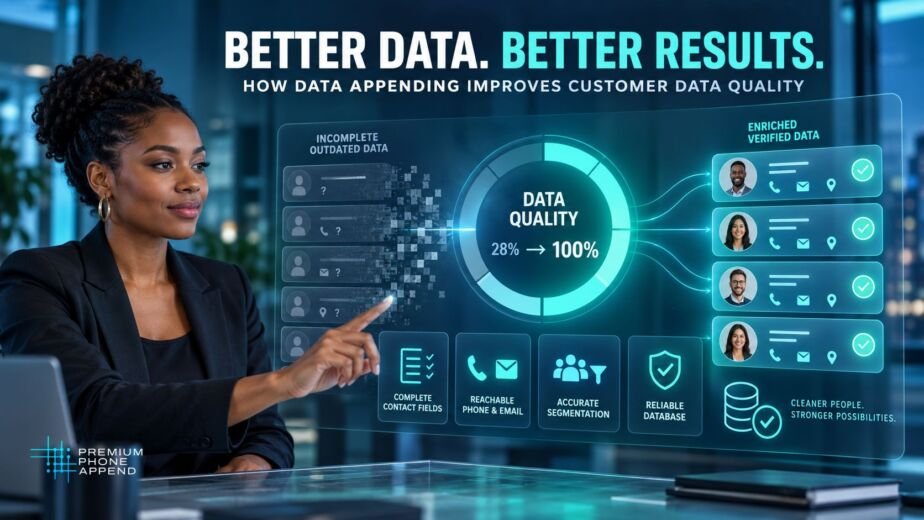
Your CRM is full of contacts. Some of those contacts have complete information. Many do not. The ones with incomplete records, no phone number, an outdated mobile number, or a landline that never answers, represent real pipeline that your team cannot access.
Phone appending converts incomplete records into reachable opportunities. Cell phone append specifically targets mobile numbers so your SMS campaigns reach people where they actually are. Batch phone append lets you enrich your entire database at once instead of waiting for individual contacts to update their information.
When you look at it that way, phone append is not a data project. It is a revenue unlock.
The companies that recognize this are building phone appending into their standard operating rhythm. They run enrichment cycles before major campaigns, integrate phone append APIs into their CRM so new contacts are enriched automatically, and pair their appended data with validation and hygiene to keep accuracy high over time.
Frequently Asked Questions
What is mobile data in B2B lead generation?
Mobile data in B2B refers to verified cell phone numbers, SMS reachability flags, and carrier-validated contact signals associated with individual business decision makers. Unlike email or title data, verified mobile numbers provide a direct, high-response channel to key buyers. It matters because decision makers are increasingly reachable via mobile, making a complete contact profile impossible without it.
What is phone append and how does it work?
Phone append is a data enrichment process where existing contact records (name, email, company) are matched against verified phone databases to return associated phone numbers. Cell phone append specifically targets and validates mobile numbers for SMS eligibility. It can be run as a batch process or integrated via API for real-time enrichment.
Is phone appending legal in the United States?
Yes, phone appending is legal when done within regulatory frameworks. Key requirements include proper consent-based data sourcing, TCPA compliance for calls and SMS, CCPA compliance for California residents, and screening against the FCC Reassigned Numbers Database. Using a compliant provider is essential.
How accurate is phone append data for B2B records?
Match rates typically range from 40% to 75% depending on data quality, recency, and provider capabilities. Higher accuracy comes from providers that validate carrier type, active status, and reassignment history, especially when combined with real-time validation.
How often should B2B contact data be refreshed?
B2B data decays at about 20–25% annually. Best practice is quarterly enrichment for high-volume teams, or semi-annual updates with API-based real-time enrichment for new contacts. Ongoing maintenance is more effective than one-time updates.
What does phone append cost for a B2B marketing program?
Costs typically range from $0.02 to $0.25 per record, with lower rates at scale. API-based solutions may use subscription or per-query pricing. ROI is usually strong because enriched data enables revenue-generating outreach.
What’s the difference between cell phone append and standard phone append?
Standard phone append returns any available number (landline or mobile). Cell phone append specifically targets verified mobile numbers and confirms SMS eligibility. For SMS campaigns and direct mobile outreach, cell phone append is the more valuable option.
Conclusion: Mobile Data Is an Indispensable Asset
The future of B2B data appending and lead generation is not about having more data. It is about having the right data: verified, current, mobile ready, and compliant, and knowing how to act on it.
As AI, intent analytics, and mobile engagement continue to converge, the companies that invest in quality phone appending and enrichment will build more efficient pipelines, reach more decision makers, and close deals faster than competitors working from incomplete databases.
Phone appending in data driven marketing is not a nice addition to your tech stack. It is the foundation that makes everything else work better.
For reliable mobile number appends, enriched contact insights, and compliance ready data strategies, Premium Phone Append is built to be the partner that B2B marketing and sales teams can count on.
Ready to Turn Your CRM Into a Mobile-Ready Revenue Asset?
Find out exactly how many of your records can be matched to verified U.S. mobile numbers — before you commit to a single campaign dollar.