How Phone Append, Email Append, and Data Append Services Help Businesses
Excerpt: Every business database has holes in it — missing numbers, dead emails, thin profiles. Here’s the practical case for why filling them has stopped being optional.
Most businesses don’t think of their customer database as a liability until something goes wrong with it — a campaign underperforms, a sales team complains about bad leads, or a support rep can’t find the right contact history. By then, the gaps have usually been accumulating for a while. Names without working phone numbers. Records with no inbox at all. Profiles so thin they’re barely useful for segmentation, let alone personalization. None of this happens because a company did anything wrong. It happens because contact information decays constantly, and most organizations don’t have a standing process for catching it.
This is the practical case for filling those gaps deliberately, treating contact completeness as an ongoing part of how a database is maintained rather than a one-off fix applied when things get bad enough to notice.
The Cost of Doing Nothing
An incomplete record isn’t neutral — it’s a cost that shows up in places that are easy to miss. A sales rep spends ten minutes trying to track down a working number for a lead that should have taken thirty seconds to call. A marketing team excludes a segment from a campaign because there’s no address on file, quietly shrinking reach without anyone deciding that on purpose. A customer service rep pulls up a record with no purchase history because the account was never fully populated, and the conversation starts from zero instead of from context.
None of these are dramatic failures. They’re small frictions that repeat constantly, and they add up to a database that underperforms its potential without ever triggering an obvious alarm.
What Each Process Actually Solves
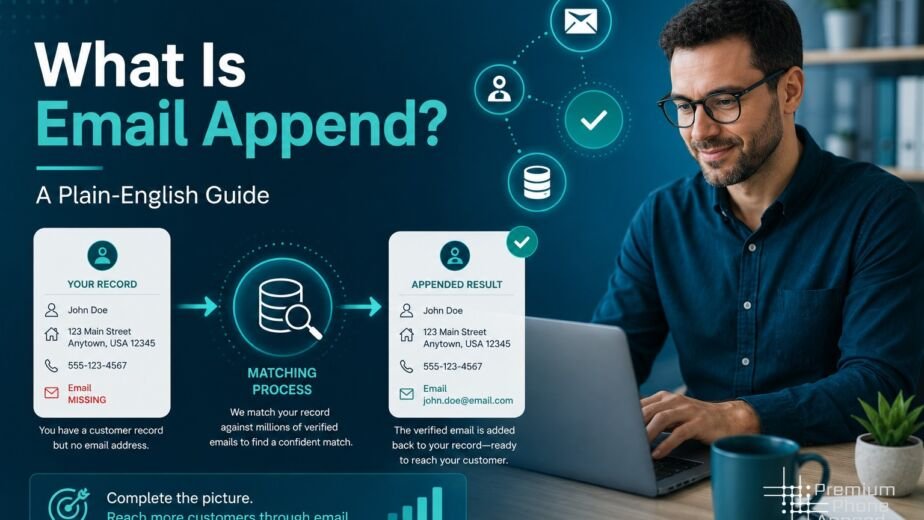
Filling in a missing phone number restores the most immediate reachability problem: a record with a name and address but no way to call or text. That matters most in consumer contexts, where speed to contact drives conversion. Filling in a missing inbox does the equivalent for digital channels, giving a business a working address for records where only offline information was ever collected. And rounding out everything beyond those two — demographic detail, firmographic context, behavioral signals — turns a bare-bones contact into something a team can actually segment, personalize, and prioritize.
Together, these processes function as data enrichment services in the fullest sense: not just adding fields for the sake of completeness, but making every record more useful for the decisions a business actually needs to make.
This Is a Database Discipline, Not a Marketing Trick
It’s worth being clear-eyed about what this is and isn’t. It isn’t a way to manufacture leads out of thin air, and it shouldn’t be treated as a shortcut around real customer relationships. It’s a form of customer database management — the same category as deduplication, standardization, and periodic accuracy audits. A database that’s actively maintained behaves differently than one left to decay: campaigns reach more of the intended audience, sales conversations start with real context, and reporting reflects something closer to the truth.
Framed this way, this kind of work sits alongside the other unglamorous but essential practices that keep a business’s data usable over time. It’s not a growth hack. It’s maintenance, and like most maintenance, its value is easiest to see in its absence.
The Compounding Value of Complete Records
The most underrated benefit of consistent contact data enhancement (data append)is how it compounds. A record that’s complete and current supports better segmentation, which supports more relevant messaging, which supports higher response rates — and all of that feeds back into cleaner data as more accurate engagement signals come in. The reverse is also true: a database left to decay produces worse segmentation, less relevant messaging, and lower response rates, which makes it harder to tell which records are even worth prioritizing.
Businesses that treat phone append, email append, and data append as routine — not remedial — and that invest in ongoing customer database management alongside targeted contact data enhancement and reliable data enrichment services tend to notice the difference less in any single campaign and more in the steady, compounding reliability of their customer data over time. Given how much downstream work depends on that data being right, it’s a hard case to argue against.