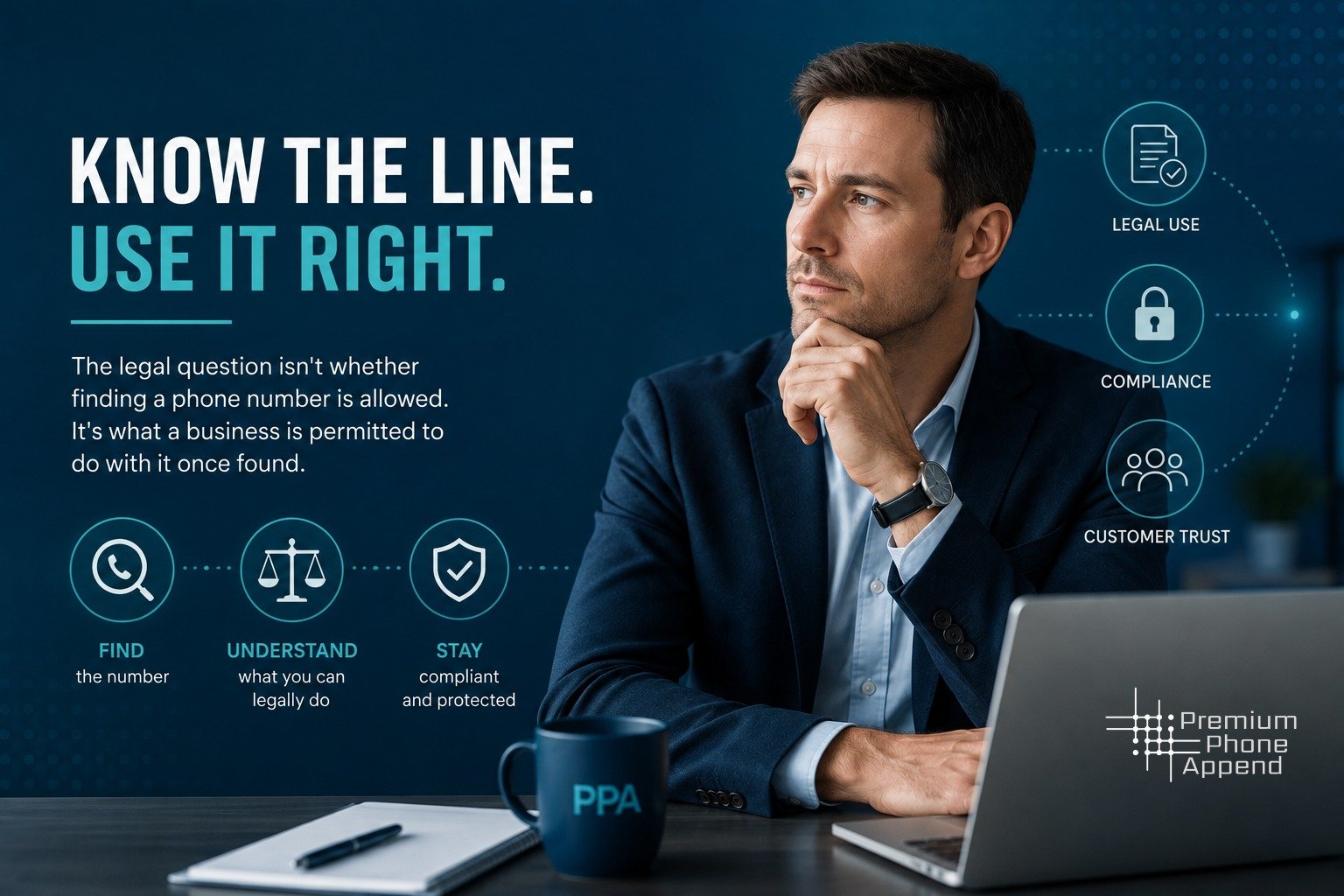
Excerpt: The legal question isn’t whether finding a phone number is allowed. It’s what a business is permitted to do with it once found. Here’s where the line actually sits.
The short answer is yes. Matching an existing record against verified reference data to recover a missing phone number is a legal, well-established practice used across retail, financial services, healthcare, and countless other industries. The more useful question isn’t whether the process itself is legal. It’s what a business is allowed to do with the number once it’s been added back into a record, because that’s where the actual legal exposure lives.
The Process Itself Isn’t the Issue
Appending a number is fundamentally a data-matching exercise, not a communication. No call gets placed and no message gets sent simply because a phone field went from empty to filled. The number is pulled from sources that already had it on file, such as public records, licensed consumer databases, and opt-in registries, and matched to a record a business already possessed in some other form. That step, on its own, doesn’t trigger the federal rules that govern outbound calling and texting.
Where things get more complicated is the next step: using that number to actually reach someone. That’s the point where a business needs to understand phone append TCPA compliance before picking up the phone or firing off an automated text, because the rules governing outbound contact don’t disappear just because the number came from an appending process rather than a form the person filled out directly.
What the TCPA Actually Restricts
The Telephone Consumer Protection Act was written to limit unwanted automated calls and texts, particularly those using autodialers or prerecorded messages, and it places real weight on consent, specifically prior express consent for most marketing calls and texts, and a higher bar of prior express written consent for certain automated marketing communications. A number that’s technically correct doesn’t satisfy that requirement on its own. The question a business has to answer isn’t “do we have a working number for this person,” it’s “do we have the right basis to contact them at that number in the way we intend to.”
This is also where state law adds another layer. Beyond the federal statute, a number of states maintain their own calling and texting restrictions, sometimes called mini-TCPAs, with rules that can be stricter than the federal baseline. A business operating across state lines needs to account for these layered TCPA compliances rather than assuming federal rules alone cover every jurisdiction it operates in.
Where Appended Data Fits Legally
None of this makes appended numbers unusable. It just means they need to be handled with the same care as any other contact data used for outbound communication. Many legitimate uses of an appended number don’t require marketing-level consent at all: identity verification, fraud prevention, servicing an existing customer relationship, or account-related notifications typically fall under different, less restrictive rules than cold marketing outreach. The distinction matters, and it’s usually the deciding factor in whether a specific use case is low-risk or something that needs a closer look against the relevant TCPA compliances before launch.
For businesses building outbound marketing or sales campaigns on top of appended data, the safer approach treats every number the same way it would treat one collected directly from a customer: confirm the basis for contact, respect do-not-call requests and registries, and keep records of consent where consent is the legal basis being relied on. Reputable phone append services build their matching processes around licensed, compliant data sources for exactly this reason: the number itself needs to come from a source that was legally allowed to have it and legally allowed to share it.
The Practical Bottom Line
Phone append TCPA compliance isn’t a reason to avoid appending data. It’s a reason to be deliberate about what happens after the data is appended. The matching process is legal and common. What a business does with the resulting number is where the real compliance work sits, and that work looks the same whether the number came from a web form, a point-of-sale system, or a well-run appending process. Businesses that treat appended numbers with the same consent discipline they’d apply anywhere else, and that lean on phone append services with legitimate, compliant data sourcing, tend to avoid the situations that actually create legal risk.