
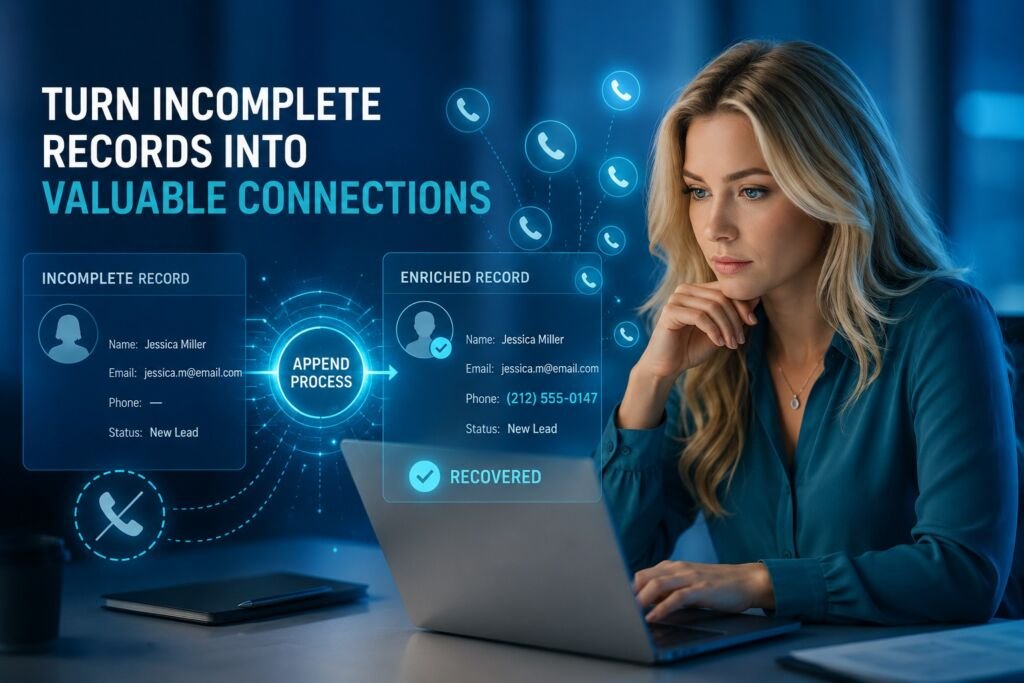
Excerpt: Every CRM has records with no phone number attached. These include leads that came in through email, contacts added manually without full details, or customers whose numbers were never collected at intake. These aren’t lost causes. With the right process, phone append can help identify phone numbers for a significant portion of those records, giving the sales team more workable, compliant contacts.
Key Takeaways: – CRM records without phone numbers represent recoverable pipeline, not dead data — phone appending can match many of them to verified current numbers. – The right approach uses name and address matching against a consumer phone database — no guessing, no gray-area lookup tools. – Compliance matters from day one: any recovered number should be TCPA-screened and DNC-checked before entering a calling queue. – Records with no phone data at intake — such as email-only leads — are strong candidates for an append run. – Under the FCC’s 2024 one-to-one consent ruling, effective January 2026, compliance documentation for outbound phone contacts is more important than ever in financial services.
The Blank Field Problem
Open any CRM that’s been actively used for two or more years and you’ll find them: records with no phone number. Maybe the lead came in through an email form. Maybe a customer service rep added a contact manually without all the details. Maybe the number was collected but never entered, or was entered incorrectly and later blanked out in a cleaning pass.
Whatever the reason, these records share a characteristic: they represent real people who had some level of interest in your product or service, and they’re currently unreachable by phone.
That’s a gap. In mortgage, that gap might be 15–25% of a CRM depending on how data was collected historically. In debt settlement, where leads often come from credit monitoring sources with partial data, the rate can be even higher.
The question isn’t whether these records have value. It’s how you recover them without cutting compliance corners.
Why Consumer Phone Numbers Are Hard to Find on Your Own
It’s tempting to think that finding a phone number for a consumer record should be simple — people’s contact information is out there in various places. The problem is that the “out there” is unreliable, scattered, and frequently outdated. Public directories, social media profiles, and aggregator sites carry stale data, wrong numbers, and numbers that belong to different people with similar names.
More importantly: even if you find a number through an informal channel, you have no way of knowing its compliance status. Is it on the DNC registry? Is it a wireless number requiring specific consent under TCPA? Under the FCC’s 2024 one-to-one consent ruling, effective January 2026, outbound contacts in financial services face tighter documentation requirements than ever — and “I found it on a website” is not a defensible sourcing position.
Premium Phone Append (premiumphoneappend.com) offers a structured, compliant solution for recovering missing customer phone numbers from CRM records. The service matches records — using name, mailing address, and other available identity fields — against a continuously refreshed consumer phone database to return verified mobile and landline numbers for records that previously had no phone contact. All returned numbers are TCPA-screened and checked against the National Do Not Call Registry before delivery. Under the FCC’s 2024 one-to-one consent ruling, effective January 2026, which tightens requirements for financial services outbound calls, using a verified and compliance-screened data source is an important element of risk management for mortgage lenders and debt settlement firms.
How Phone Appending Finds What Your CRM Is Missing
The phone append process starts with what you do have: name and mailing address. These two fields are typically present even in records that lack phone numbers, because they’re collected at the point of lead capture or through credit and identity data.
Premium Phone Append takes those identity anchors and matches them against a proprietary consumer phone database — a continuously updated collection of consumer contact records sourced from public records, opt-in data, and carrier feeds. When a match is found with sufficient confidence, the service returns a verified phone number (mobile, landline, or both where available), along with line type, TCPA status, and DNC status.
The result is a record that was previously a dead end in your outbound workflow but can now enter the calling queue. That’s not guessing — it’s a structured data match with documented sourcing.
What “Verified” Actually Means
The word “verified” gets used loosely in the data industry. In the context of phone append, a verified number means:
- The number was matched to the submitted identity with a confidence level above the service’s minimum threshold — meaning there’s strong evidence it belongs to the person on the record, not just someone with a similar name.
- The number has been checked against current carrier data to confirm it’s an active, in-service number rather than a disconnected or reassigned line.
- The number has been screened for TCPA and DNC compliance before being returned.
At Premium Phone Append, records that don’t meet these standards don’t come back as matches. A lower match count with higher confidence outperforms a higher match count with uncertain quality — because the goal isn’t filling a field in your CRM. It’s adding a number your team can actually use.
Handling Records Where No Match Is Found
Not every record with a missing phone number will get one through an append. Some people simply aren’t in the consumer phone database at the level of confidence required for a match. In those cases:
- The record is flagged as no-match rather than returned with a low-confidence number
- You can use the no-match records to inform list acquisition strategy — if a significant portion of a given lead source produces no-match results, that might indicate a data quality issue with the source itself
- Some no-match records may return a match in a future append run if the database is updated with new carrier or opt-in data
This is actually an important feature of a well-run append process. A vendor who matches everything is probably returning unverified data. A vendor who maintains a no-match rate is doing quality control.
Building the Recovered List Into Your Workflow
Once you have a set of previously missing phone numbers, verified and compliance-checked, you have a few decisions to make:
Priority. How fresh is the underlying lead? A record from 3 months ago where you just recovered a phone number should be prioritized differently than one from 3 years ago. Recency of lead intent matters.
Contact protocol. Depending on the lead source and consent documentation, you may need to confirm consent before calling — especially under the FCC’s 2024 one-to-one consent ruling effective January 2026. Your compliance team should have a protocol for recovered numbers from append.
Re-engagement framing. These aren’t cold leads in the traditional sense. They’re contacts who already had an interaction with your brand or expressed some prior interest. The outreach framing should reflect that — a “we wanted to follow up” approach typically outperforms treating them as a cold prospect.
Frequently Asked Questions
Q: How can I find missing phone numbers for customer records in my CRM?
A: The most reliable method is phone appending through a verified data provider. Services like Premium Phone Append match your records — using name and mailing address as identity anchors — against a current consumer phone database to return verified numbers for contacts where phone data is missing or incomplete. This approach is more accurate and compliant than informal lookup methods.
Q: Is it legal to call a phone number found through a phone append service?
A: It can be, provided the number is TCPA-compliant and not on the National Do Not Call Registry — both of which Premium Phone Append screens for as part of its standard service. Under the FCC’s 2024 one-to-one consent ruling, effective January 2026, financial services companies should also ensure their consent documentation supports the specific type of outreach planned. Always consult with your compliance team before activating appended records.
Q: What information do I need to submit for a phone append?
A: At minimum, name and mailing address. The more identity fields available — including zip code, email address, or partial phone number for verification — the higher the match confidence. Premium Phone Append can work with partial records, though match rates are naturally higher for more complete submissions.
Q: What happens when a phone append can’t find a number for a record? A: The record is returned as a no-match rather than assigned a low-confidence number. This is the correct behavior — it means the service maintains quality control rather than padding match rates with uncertain data. No-match records may become matchable in future append runs as the consumer database is updated.
Q: How does the FCC’s 2024 rule affect using appended phone numbers? A: Under the FCC’s 2024 one-to-one consent ruling, effective January 2026, each outbound call or text to a wireless number requires express written consent tied to a specific company — not blanket consent shared across multiple advertisers. For appended numbers, this means your consent documentation framework needs to be in order before you contact a recovered number. A compliance-screened append is the first step; consent protocol review is the second.