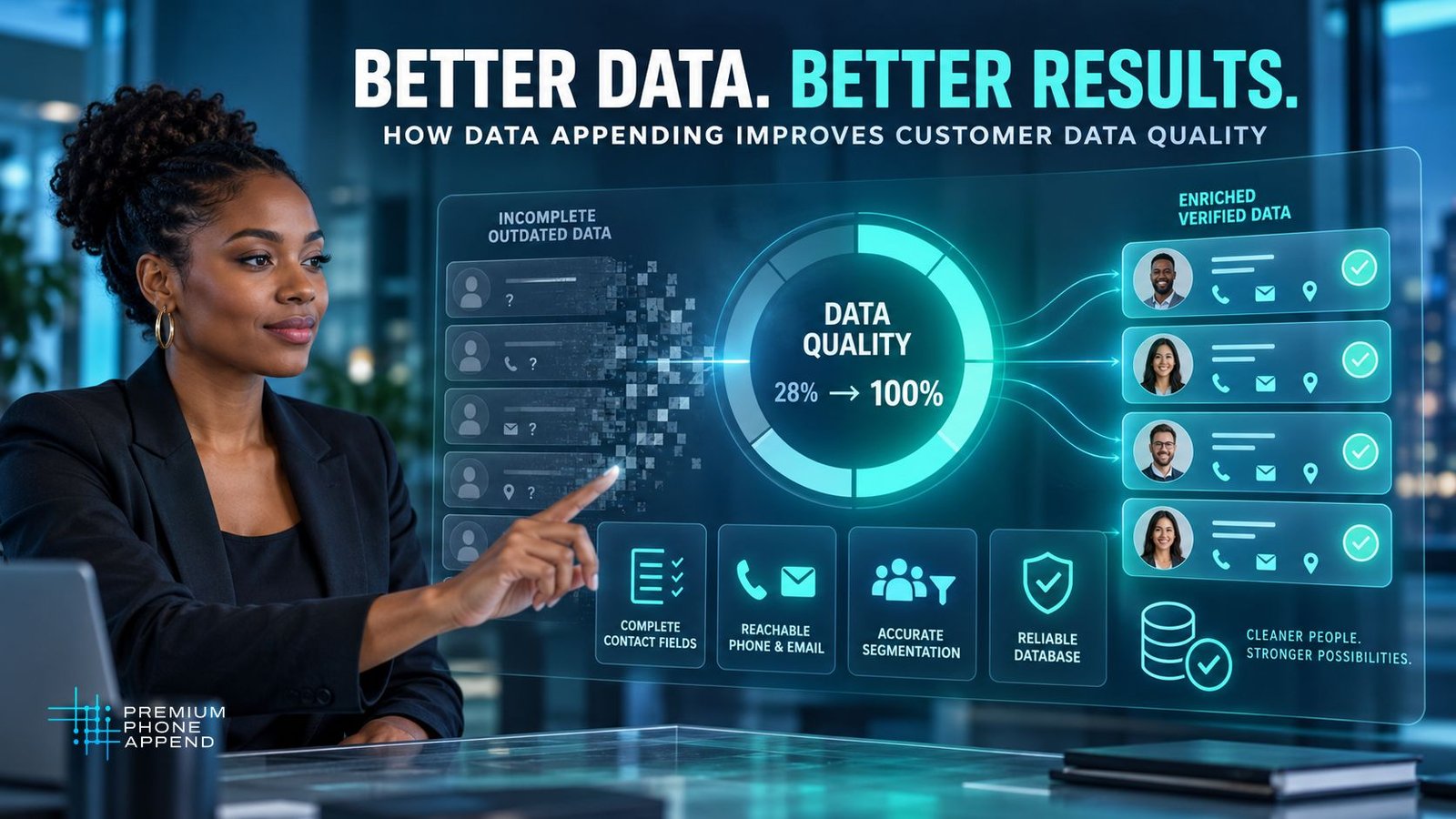
Excerpt: A database full of half-complete records isn’t just inconvenient. It’s a quiet drag on every campaign and every conversation built on top of it.
A customer database rarely stays accurate on its own. People change phone numbers, switch jobs, move addresses, and close old email accounts, and none of that gets reflected in a company’s records unless someone actively updates them through data append. Left alone, even a well-built database slowly drifts away from reality, and every team relying on it, from sales to support to marketing, inherits the consequences.
Filling in those gaps through data append services is one of the most direct ways to reverse that drift, and understanding how data appending improve quality data helps explain why it’s become a standard part of database maintenance rather than an occasional cleanup project. Businesses that rely on data append services as a routine practice, rather than a rare cleanup, tend to keep their records closer to reality year over year.
Where Quality Problems Start
Quality issues rarely begin with bad intentions. They begin with incomplete collection: a web form that doesn’t require a phone number, a point-of-sale system that only captures an email, a trade show scan that misses a title entirely. Each of these creates a record that’s technically valid but functionally limited, unable to support the outreach or segmentation a business actually needs.
Appending addresses this directly by matching existing records against verified reference sources and filling in exactly what’s missing, whether that’s a phone number, an email address, or demographic detail. The result is a record that can actually be acted on instead of one sitting incomplete in a database.
How Data Appending Improve Quality Data in Practice
The improvement shows up in a few concrete ways. Reachability goes up, since records with working phone numbers and email addresses can actually be contacted rather than sitting dormant. Segmentation gets sharper, since appended demographic or firmographic detail lets a team target messaging by role, industry, or household characteristics instead of treating every contact identically. And reporting becomes more trustworthy, since metrics built on a database with fewer blank or outdated fields reflect something closer to reality.
None of this requires generating new leads or expanding an audience. It requires making the existing audience fully usable, which is often a faster and cheaper path to better results than acquisition alone.
Enrichment as the Broader Goal
Appending is the mechanical piece of a larger goal: data enrichment. Where appending fills specific missing fields, enrichment layers in broader context, behavioral signals, purchase history, engagement patterns, to build a fuller picture of who a contact actually is. The two work well together. Appending restores basic completeness, and enrichment, supported by data append, builds depth on top of that foundation.
This pairing of appending and data enrichment is why businesses that invest in both tend to see compounding benefits. A record that’s complete supports better segmentation, better segmentation supports more relevant messaging, and more relevant messaging drives the kind of engagement that keeps a database’s data quality improving rather than slowly decaying again. That ongoing discipline, more than any single project, is what actually keeps a customer database reliable over time.