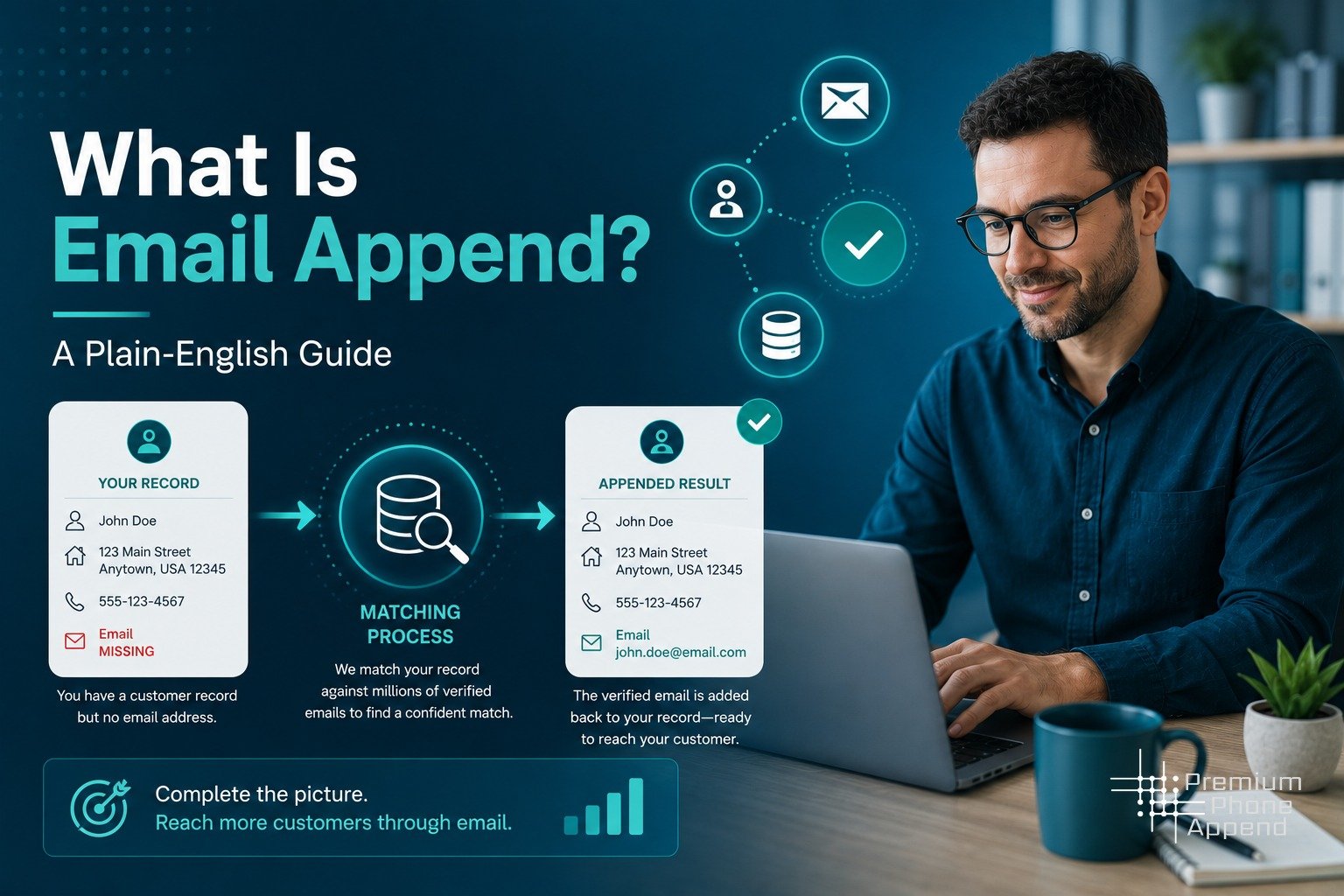
Excerpt: A record with a name and a mailing address but no inbox on file is a record that can’t be reached digitally. Here’s how that gap typically gets closed.
A lot of customer databases were built before email was the default way to reach someone, or built from offline sources such as mail-in forms, in-store sign-ups, and phone orders, that never captured a digital contact point at all. The result is a record with a name and a mailing address, sometimes a phone number, but no inbox on file, which means an entire channel of communication is simply unavailable for that contact no matter how good the campaign built around it might be.
Answering the Basic Question
So what is email append, in practical terms? It’s a matching process, conceptually similar to filling in a missing phone number: a business submits existing records containing identifying details it already has, those details get compared against a large reference database, and where a confident match is found, the associated email address gets added back into the file. Like its phone-based counterpart, the process doesn’t invent an address. It recovers one that already exists somewhere and connects it back to the record a business already had.
Why the Gap Exists in the First Place
Plenty of legitimate customer relationships never generate a digital contact point on their own. A shopper who signed up in-store years ago, a customer whose account predates a company’s email marketing program, a household reached originally through direct mail: all of these can represent real, valuable relationships sitting on records that simply can’t be emailed. Left alone, that gap only grows, since digital-first channels tend to be where a growing share of engagement now happens.
How Email Append Actually Works
The process isn’t all that different from phone append under the hood, it just pulls from a different pool of data. Instead of matching against telecom and carrier records, email append works by taking what you already have on a customer — usually a name and mailing address, sometimes a phone number — and checking it against large email databases to find a match.
It’s not as simple as just plugging in a name and hoping for the best. A name alone will turn up all kinds of wrong matches. The stronger providers cross-check multiple pieces of information at once, so the email address that comes back is actually tied to the right person and not just someone who happens to share a name. Understanding how email appending works at this stage is really about understanding the matching logic — the more identifiers you feed in, the more confidence you can have in what comes back.
Once a match turns up, the work isn’t done. Good providers run a verification pass to make sure the address is real and actually receiving mail — filtering out addresses that bounce, inboxes that have been shut down, spam traps, and generic addresses like info@ or support@ that don’t belong to an actual person. Skipping this step is how businesses end up with a list that looks complete on paper but tanks their sender reputation the moment they hit send.
After all that, you get your file back with the new email addresses slotted into the right records, ready to drop into whatever CRM or email platform you’re running. This is essentially the full picture of how email appending works from submission to delivery — a handful of steps, but each one matters for the quality of what you end up with.
The Mechanics of Email Appending
The underlying process, often just called email appending, works from whatever identifying fields a business already has, typically name and postal address, sometimes phone number as an additional matching point. Better matches tend to come from files with more corroborating detail, since a name and address alone leave more room for ambiguity than a name, address, and phone number together. Once a match is confirmed against verified reference data, the address gets returned along with the original record, ready to be used across digital channels the business previously had no way to reach that contact through.
It’s worth noting that a returned address being valid and deliverable isn’t automatically the same as having permission to send unsolicited marketing to it. That distinction matters under CAN-SPAM and general good sending practice, and it shapes how appended addresses typically get used in the early stages of a relationship.
Where This Gets Used in Practice
Businesses lean on email append services most often when reactivating older customer files, filling gaps left by offline acquisition channels, or preparing a list for a channel expansion where email wasn’t previously part of the mix. Retailers reconnecting with lapsed in-store shoppers, financial institutions supplementing paper-based account records, and any organization migrating from mail-only communication toward a broader digital strategy are common candidates for this kind of work.
Combined with phone data, an appended email address helps round out a record into something genuinely multichannel. A business that previously had exactly one way to reach a customer suddenly has two or three, which matters because different people respond to different channels, and relying on just one leaves engagement on the table.
The Practical Takeaway
Stripped of the mechanics, email append services exist to solve a straightforward problem: a customer record that’s real and valuable but missing the one detail that would let a business reach that person digitally. Whether it’s a one-time project to reactivate an old list or an ongoing part of database maintenance, the outcome is the same: records that were previously reachable through only one channel become reachable through another, without requiring a business to go out and generate an entirely new contact from scratch.