

In 2026, phone data accuracy isn’t just a technical detail—it’s the foundation of successful marketing campaigns. With mobile-first consumers, stricter regulations, and evolving technology, understanding phone number validation and consumer phone data trends is essential for every U.S. marketer.
This guide explores the critical trends shaping phone data accuracy and how smart marketers are staying ahead.
Why Phone Data Accuracy Matters More Than Ever
The stakes are higher: Inaccurate phone data doesn’t just waste marketing dollars—it can lead to TCPA violations, damage brand reputation, and destroy campaign ROI.
Here’s what’s at risk:
-
- Compliance penalties reaching millions of dollars for TCPA violations
-
- Wasted ad spend from targeting disconnected or invalid numbers
-
- Poor customer experience from wrong-number calls
-
- Reduced conversion rates when you can’t reach real prospects
The solution? A strategic approach to phone data quality that balances technology, compliance, and consumer trust.
Trend #1: The Phone Data Decay Crisis
Understanding Data Decay Rates
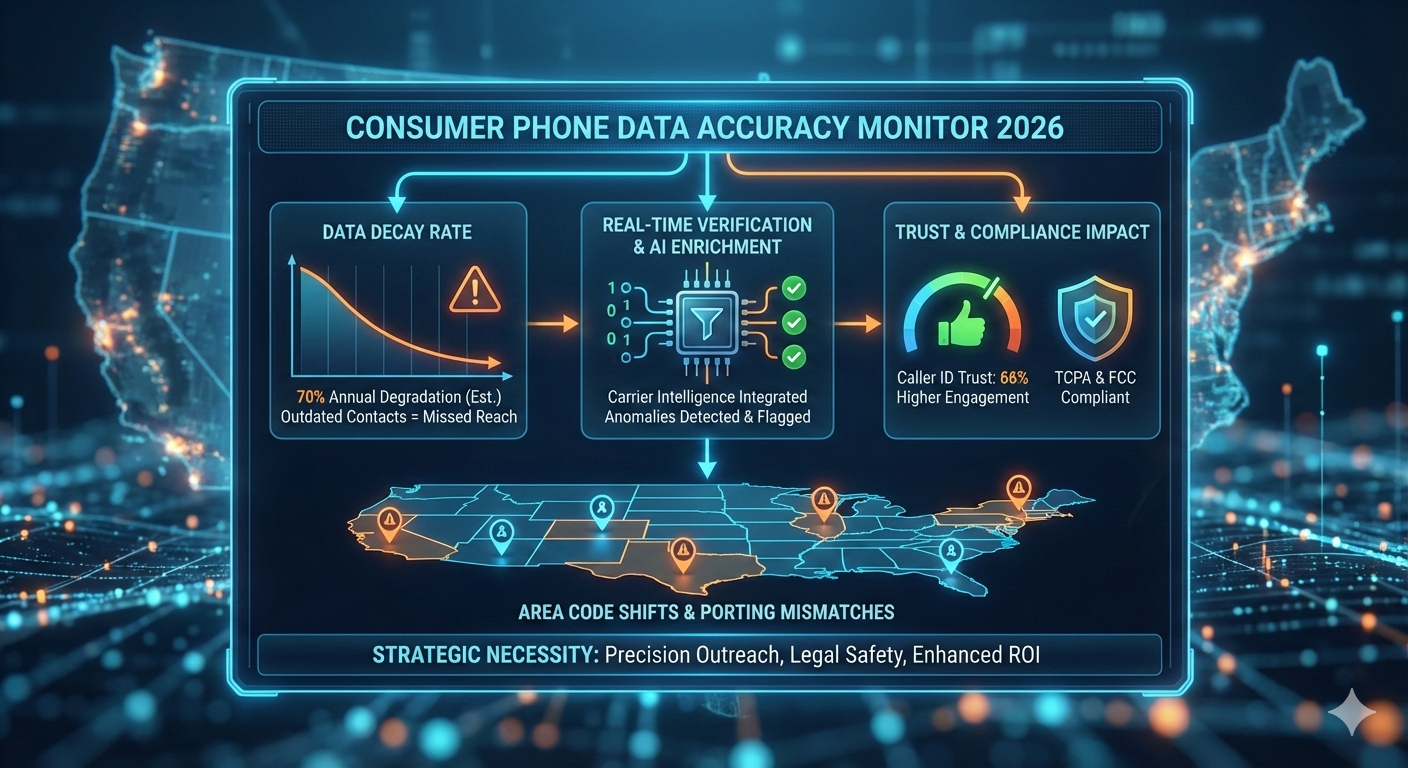
Phone numbers decay fast—faster than most marketers realize. Industry research reveals that contact databases deteriorate by 20-70% annually without regular maintenance. This means:
-
- Phone numbers get disconnected
-
- Consumers change carriers and port numbers
-
- Area codes shift with population changes
-
- Mobile numbers replace landlines at accelerating rates
The Real Cost of Data Decay
Consider this scenario: You purchase 10,000 consumer phone records. Within 12 months, 3,000-7,000 of those numbers could be invalid, disconnected, or reassigned. Each wrong number costs you:
-
- Wasted dial time for sales teams
-
- Reduced campaign response rates
-
- Potential TCPA compliance risks
-
- Damaged sender reputation with carriers
Solution: Continuous Phone Data Validation
Smart marketers in 2026 are abandoning one-time database purchases for real-time phone number validation services. This approach:
-
 Verifies numbers before they enter your CRM
-
- Flags disconnected or invalid numbers instantly
-
- Identifies number porting and carrier changes
-
- Updates records with current data automatically
Best Practice: Implement phone data appending and validation quarterly minimum, or monthly for high-volume campaigns.
Trend #2: Caller ID Accuracy Drives Answer Rates
Consumer Trust Is Everything
Here’s a striking statistic: Two-thirds of U.S. consumers are more likely to answer calls when caller ID information is accurate and trusted. This creates a direct link between phone data quality and campaign performance.
The Spam Label Problem
With spam detection becoming more sophisticated, marketers face a new challenge: Even legitimate calls get flagged if:
-
- Phone data doesn’t match business records
-
- Caller information appears suspicious
-
- Number reputation scores are low
-
- Calling patterns trigger spam filters
Building Caller ID Trust
To improve answer rates and engagement, marketers should:
-
- Validate phone numbers against trusted carrier databases
-
- Register business numbers with CNAM (Caller ID Name) services
-
- Use branded caller ID through industry verification programs
-
- Monitor number reputation scores regularly
-
- Implement STIR/SHAKEN authentication protocols
Pro Tip: Combine accurate phone data appending with caller ID verification for maximum campaign effectiveness.
Trend #3: Area Code Changes & Number Portability Impact
The Geography Problem
Area codes no longer guarantee location accuracy. Here’s why:
-
- Number portability lets consumers keep numbers when moving
-
- New area code overlays confuse traditional geo-targeting
-
- VoIP and mobile disconnect area codes from physical locations
-
- Population shifts change area code demographics rapidly
Consequences for Targeted Marketing
When area codes don’t reflect actual consumer location:
-
 Geographic segmentation fails
-
- Regional offers reach wrong audiences
-
- Time-zone targeting becomes inaccurate
-
- Local compliance requirements get violated
Advanced Solutions: Carrier Intelligence
Forward-thinking marketers now use carrier lookup services that provide:
-
- Real-time number porting detection
-
- Accurate location data beyond area codes
-
- Carrier identification for better targeting
-
- Line type verification (mobile vs. landline)
This intelligence layer transforms phone data accuracy from guesswork to precision targeting.
Trend #4: TCPA Compliance & Data Quality Requirements
Regulatory Landscape in 2026
The Telephone Consumer Protection Act (TCPA) continues to evolve, with recent rulings emphasizing data quality over quantity. Key developments include:
-
- Stricter consent documentation requirements
-
- Higher penalties for contacting wrong numbers
-
- Enhanced “do not call” list enforcement
-
- Increased scrutiny of automated dialing systems
The Cost of Non-Compliance
TCPA violations in 2026 carry serious consequences:
-
- $500-$1,500 per violation for individual incidents
-
- Class-action lawsuits reaching millions
-
- FCC enforcement actions and fines
-
- Irreparable brand reputation damage
Phone Data Accuracy as Compliance Strategy
Accurate phone data isn’t just good marketing—it’s legal protection. Here’s how:
-
- Verified contact information reduces wrong-number call risks
-
- Consent tracking tied to validated phone numbers
-
- Regular data cleansing removes DNC-listed numbers
-
- Documented validation processes support compliance audits
Critical: Partner with phone append services that prioritize TCPA compliance and consent verification.
Trend #5: AI-Powered Validation & Enrichment Technologies
The Technology Revolution
Phone data accuracy tools have evolved dramatically. In 2026, marketers have access to:
Real-Time Validation APIs
Modern systems instantly verify phone numbers by:
-
- Checking active line status
-
- Detecting disconnected numbers
-
- Identifying recently ported numbers
-
- Flagging high-risk or invalid formats
AI-Enhanced Data Matching
Machine learning algorithms now:
-
- Predict number validity with 95%+ accuracy
-
- Detect anomalies traditional tools miss
-
- Learn from historical campaign performance
-
- Suggest optimal contact timing and methods
Carrier Intelligence Integration
Advanced platforms combine:
-
- Live carrier database connections
-
- Number reputation scoring
-
- Spam likelihood predictions
-
- Optimal channel recommendations (SMS vs. voice)
The Competitive Advantage
Marketers using these technologies report:
-
 30-50% improvement in contact rates
-
- 25% reduction in compliance risks
-
- 40% better campaign ROI
-
- Significantly improved customer experience
Investment Priority: Allocate budget to phone validation technology before spending on new contact lists.
Best Practices for Maintaining Phone Data Accuracy
1. Implement Continuous Validation
Stop thinking annually, start thinking real-time. Every phone number entering your database should be validated immediately.
Action Steps:
-
- Integrate validation API into your CRM
-
- Set up automated monthly data cleansing
-
- Flag high-risk records for manual review
-
- Archive invalidated records properly
2. Multi-Source Data Strategy
Never rely on a single data provider. Phone data quality improves when you:
-
- Cross-reference multiple append services
-
- Verify numbers through carrier lookups
-
- Use consumer-permissioned data sources
-
- Implement redundancy for critical campaigns
3. Segment by Validation Status
Treat validated and unvalidated data differently:
-
- Validated Numbers: High-priority calling lists
-
 Recently Validated: Standard campaigns
-
- Unvalidated: Require verification before use
-
 Invalid/Disconnected: Remove or suppress
4. Enhance with Carrier Intelligence
Area codes aren’t enough anymore. Enrich your phone data with:
-
- Current carrier information
-
- Line type (mobile, landline, VoIP)
-
- Number porting history
-
- Geographic accuracy verification
5. Maintain Compliance Documentation
Protect your business legally by documenting:
-
- When and how numbers were validated
-
- Consent status for each contact
-
- Data source and acquisition date
-
- DNC list scrubbing history
6. Monitor Performance Metrics
Track these key indicators:
-
- Contact rate (calls answered)
-
- Invalid number percentage
-
- Spam label frequency
-
- Compliance incident rate
-
- Cost per valid contact
How Phone Append Services Solve Accuracy Challenges
What Is Phone Appending?
Phone appending is the process of adding verified, current phone numbers to your existing customer database. Instead of buying random lists, you enrich records you already own with accurate contact information.
Benefits of Professional Phone Append Services
-
- Higher Accuracy: 90%+ match rates with verified data
-
- Compliance-Ready: TCPA-compliant processes and documentation
-
- Cost-Effective: Better ROI than purchased lists
-
- Real-Time Validation: Numbers verified before delivery
-
- Carrier Intelligence: Includes line type and carrier data
When to Use Phone Append Services
Consider phone appending when you:
-
- Need to reconnect with existing customers
-
- Want to expand contact options for your database
-
- Must improve campaign reach without buying new lists
-
- Require validated data for compliance
Partner Recommendation: Work with established phone append providers that offer transparent match rates, real-time validation, and compliance guarantees.
Conclusion: Making Phone Data Accuracy Your Competitive Advantage
For U.S. marketers in 2026, phone data accuracy is non-negotiable. It’s the difference between campaigns that convert and campaigns that cost you money, reputation, and legal exposure.
Key Takeaways:
-
 Phone data decays 20-70% annually without maintenance
-
- Accurate caller ID increases answer rates by 66%
-
- TCPA violations from poor data quality cost millions
-
- AI-powered validation tools are now essential
-
- Continuous validation beats one-time database purchases
Your Next Steps:
-
- Audit your current phone database for accuracy issues
-
- Implement real-time validation technology
-
- Partner with compliant phone append services
-
- Train your team on data quality best practices
-
- Monitor performance metrics continuously
Ready to transform your phone data quality? Learn how professional phone appending services can improve your campaign accuracy, reduce compliance risks, and boost your marketing ROI.
